





Solar's Flexibility Premium: Where Grid Timing Now Outweighs Module Price
Report date: 21 August 2026 (Beijing Time)
Coverage: 20 August 2026, 04:00 to 21 August 2026, 04:00 BJT, extended to the last verified published report on 17 August for high-value signals.
One-line takeaway
Solar's commercial premium is moving from cheap generation to controllable delivery: Europe's drought-stressed grid is rewarding storage and time-shifting, while softer module prices make bankable engineering, grid readiness and channel execution the real differentiators.
Priority hot topics ranked by sales value
1. Solar is changing Europe's hydro operating pattern, creating a visible flexibility premium
Event date: 1 June–15 August 2026 | Publication date: 20 August 2026 | Priority / confidence: Critical / High
Across ten European systems with complete long-term data, hydro generation during the period was 6.0% below the comparable drought summer of 2022, while solar output rose from 45.27 TWh in 2022 to 84.44 TWh in 2026. The operational signal matters more than the headline volume: pumped storage's peak charging hour moved from around 04:00 to 13:00–14:00, and the reported correlation between hourly solar output and pumping rose to 0.86. This supports a direct sales argument for solar-plus-storage, forecast-driven controls and projects designed around export windows rather than annual yield alone. France, the Alpine region and the Danube corridor deserve particular attention because hydro deficits there increase the value of flexible solar delivery.
Sources: WSP analysis published by pv magazine · ENTSO-E Transparency Platform
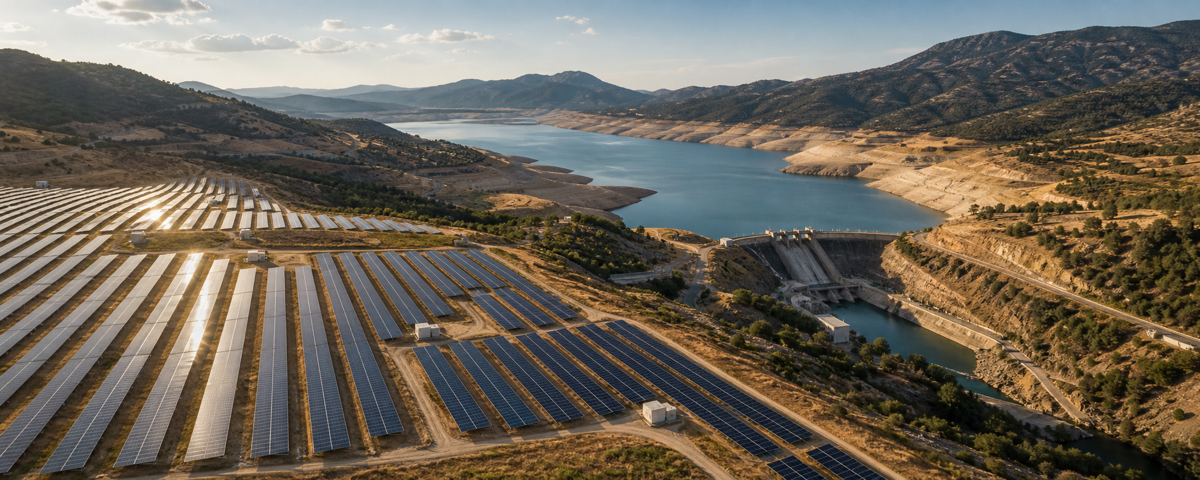
Solar surplus increasingly changes when storage charges and when renewable electricity becomes commercially valuable.
2. European module prices remain soft, but the benchmark change makes headline comparisons less reliable
Event date: Price index measured as of 14 August 2026 | Publication date: 18 August 2026 | Priority / confidence: High / Medium-high
European module prices were broadly stable with renewed declines in some segments as surplus stock continued to pressure large-rooftop and utility-scale offers. The index also raised the efficiency boundary between mainstream and high-efficiency products from 23.0% to 23.5%, placing utility formats above roughly 635 W or 730 W, depending on form factor, in the high-efficiency category. That reclassification can distort month-to-month comparisons. Commercially, buyers should not treat a lower index print as proof that every 730–750 W offer has become cheaper. Sales teams should quote by exact power class, efficiency, form factor, warranty, delivery point and inventory age, and should make the index-method change explicit in negotiations.
Source: pvXchange market commentary published by pv magazine
3. Dublin Airport's active PV-plus-BESS procurement creates an immediate European project signal
Event date: Expression-of-interest deadline 24 August 2026, 15:00 local time | Publication date: 23 July 2026 | Priority / confidence: High / High
Dublin Airport Authority is seeking a single-supplier agreement for a large-scale photovoltaic installation integrated with battery storage, with a 24-month contract duration and an imminent expression-of-interest deadline. Although the notice predates the 72-hour monitoring window, the deadline makes it a current sales trigger. The most realistic route is not a late direct bid, but immediate engagement with qualified Irish EPCs and consortium leaders that may still need compliant module, storage or balance-of-system supply. Airport projects typically place extra weight on fire strategy, operational continuity, glare management, documentation and programme certainty; a generic module quotation will be weaker than a project-specific compliance and delivery pack.
Sources: Official Irish eTenders workspace · Official contract notice

Complex energy users increasingly procure solar, storage and operating resilience as one integrated delivery package.
4. India's 150 GW construction pipeline is large, but curtailment and unsigned PPAs constrain bankability
Event date: Pipeline status as of 30 June 2026; awards updated to 10 August 2026 | Publication date: 19 August 2026 | Priority / confidence: High / High
India had more than 150 GW of renewable capacity under construction at the end of June, but tender awards slowed from 40.6 GW in fiscal 2024–25 to 14.7 GW in 2025–26, with 4.7 GW awarded by 10 August in the current financial year. ICRA also cited 40–45 GW of unsigned PPA capacity and curtailment of 30%–50% during solar hours at some affected substations operating under temporary grid access. Around 90 GWh of BESS capacity had been awarded, under construction or operating by June. The lesson for suppliers is that pipeline size alone is not a demand forecast: prioritize projects with signed offtake, credible connectivity and storage economics, and avoid extending aggressive terms solely on the basis of announced capacity.
Sources: Central Electricity Authority under-construction reports · ICRA findings summarized by pv magazine
5. BYD turns 233 Brazilian dealerships into a distributed-solar sales channel
Event date: 20 August 2026 | Publication date: 20 August 2026 | Priority / confidence: Medium-high / Medium-high
BYD began offering standardized 4.8 kWp residential kits through 233 dealerships in Brazil. The package combines eight 600 W modules, inverter, mounting, cabling, installation, utility approval and one year of insurance; financing is also integrated. The strategic point is the route to market: a familiar physical channel, bundled service and financing reduce customer friction more effectively than another incremental module-specification claim. European distributors can adapt the model by packaging modules with installer allocation, grid paperwork, monitoring, warranty handling and optional storage. The competitive threat is therefore not only product price—it is a smoother buying process.
Source: pv magazine report
6. Malaysia's updated net-metering rules reward precise channel segmentation
Event date: Updated programme rules active in 2026 | Publication date: 20 August 2026 | Priority / confidence: Medium / High
The updated rules cap residential systems at 5 kWac for single-phase and 12.5 kWac for three-phase connections, while the government scheme can reach 1 MW subject to network limits. Excess generation receives a one-for-one consumption credit that can roll forward for up to 12 months, and systems above 72 kW require an assessment study. This is a reminder that the same module portfolio should be sold through different system architectures: compact residential packages for household caps, and engineering-led commercial or public-sector offers where grid studies, protection design and compliance documentation drive conversion.
Sources: Malaysia Energy Commission guidelines · pv magazine summary
7. Alternative module-frame materials move from cost discussion to qualification risk
Event date: Industry feature published 20 August 2026 | Publication date: 20 August 2026 | Priority / confidence: Medium / Medium
Thinner aluminum profiles, larger module formats, domestic-content requirements and embodied-carbon targets are encouraging suppliers to evaluate steel and glass-composite frames. The opportunity is real, but substitutions change corrosion exposure, grounding, clamping behaviour, transportation loads and installer handling. For high-power modules, the safest commercial position is evidence-led: require mechanical-load results, corrosion testing, compatible clamp zones, installation instructions and traceable bill-of-material controls before presenting a new frame as equivalent. Procurement teams should treat an unqualified frame change as a bankability event, not a cosmetic specification update.
Source: pv magazine feature on steel and glass-composite frames
European sales opportunities
| Market / target account | Product entry point | Why now | Recommended follow-up |
|---|---|---|---|
| France, Italy, Austria, Romania and the Danube corridor; utilities and hybrid-project developers | High-efficiency modules plus two-to-four-hour storage and forecast-based dispatch | Weak hydro availability increases the value of midday absorption and evening delivery | Lead with hourly production and revenue-shifting cases; request the site's curtailment and price-spread profile |
| Ireland; airport and critical-infrastructure EPCs | Documented 730–750 W modules, BESS integration support, fire and glare documentation | Dublin Airport's procurement deadline is imminent | Contact qualified Irish EPCs with a concise compliance matrix, delivery window and logistics plan |
| Germany and Benelux distributors | Traceable high-efficiency inventory with clear age, warranty and frame specification | Spot pricing is soft, but index reclassification complicates comparisons | Offer named-lot stock and a like-for-like comparison sheet; avoid broad index-based discounting |
| European residential and light-C&I distributors | Bundled solar, storage, installer allocation and financing-ready packages | The dealership model demonstrates the conversion value of a complete buying journey | Pilot one standardized package with fixed scope, installation SLA and warranty owner |
Risks and warnings
- Policy: Germany's EEG 2027 and grid-package debate can create pull-forward demand followed by a fourth-quarter pause.
- Pricing: The 23.5% index boundary can exaggerate technology-level price movement. Quote exact specifications and delivery terms.
- Grid: High solar penetration without connection certainty or storage can turn large announced pipelines into delayed procurement and curtailment.
- Supply chain: Alternative frame materials require renewed mechanical, corrosion, grounding and logistics validation.
- Competition: Bundled finance, approval and installation can beat a technically stronger standalone module.
- Sentiment: No verified crisis-class public signal concerning Solligent was found on the measured open-web sources in this sweep.
Brand and competitor dynamics
| Entity / signal | Class | Commercial interpretation | Routing / SLA |
|---|---|---|---|
| BYD solar kits through 233 Brazilian dealerships | lead | A route-to-market benchmark built on physical distribution, service bundling and financing | Channel strategy review within one business day |
| Steel and glass-composite module-frame push | question | Answer equivalence questions with qualification evidence, not marketing claims | Product and quality response within one business day |
| Solligent | question | No reliable new public mention identified; no public claim should be made | Recheck next scheduled report |
No verified crisis, bug, praise or spam item met the evidence threshold in this sweep.
Seven-day trend
Baseline building. Four report observations are available in the current seven-day window: 14, 17, 19 and 21 August. The 19 August report remained an unpublished local draft, so it is included only as an internal comparison point. Flexibility and grid access remain persistent themes rather than a measured spike. The clearest directional change is commercial: module-price momentum softened while active tenders and operating data increasingly reward storage, grid readiness and integrated delivery. No numeric social-mention spike is declared because the monitored sources do not provide a stable cross-platform daily denominator.
Coverage disclosure
| Coverage class | Sources used | What is supported | Limitation |
|---|---|---|---|
| Measured | Government and regulator pages, official procurement notices, company or project pages, and dated industry publications | Publication dates, stated capacities, deadlines, programme rules and reported market observations | Each metric is measured only for its cited source; no cross-platform mention total is inferred |
| Proxy | Open-web search and public news coverage used as adjacent signals for closed-platform discussion | Topic presence and corroboration on the public web | X, Instagram, TikTok, LinkedIn, Xiaohongshu, WeChat, WeChat Channels and Douyin were not measured directly |
| User-provided | Report scope, publication rules and brand rules | Editorial and workflow constraints | No user-provided platform export or native social analytics was supplied for this period |
Three immediate sales actions
- Build a flexibility-first proposal for Southern and Central Europe. Add an hourly generation, storage-charge and evening-delivery page to every utility or C&I proposal in France, Italy, Austria, Romania and the Danube region.
- Contact Irish EPCs before the Dublin Airport deadline. Send a one-page pack covering module availability, 730–750 W options, fire and glare documentation, warranty ownership and delivery lead time.
- Protect margin with like-for-like quoting. Reissue distributor comparisons by exact efficiency, wattage, form factor, frame bill of materials, inventory age and delivery point; do not negotiate from a blended market index alone.