





Deye Commercial & Industrial Energy Storage: From 30–50 kW Hybrid Inverters to 122.8 kWh Battery Cabinets
Product guide checked on 14 October 2026, Beijing Time.
Executive takeaway
Deye’s most practical small-scale commercial and industrial proposition is not one isolated battery or inverter. It is a choice between two architectures: an integrated 122.8 kWh outdoor cabinet for buyers who want a compact, factory-coordinated system, and a modular BOS-G high-voltage rack for projects that need finer capacity steps. The 30 kW and 50 kW three-phase high-voltage hybrid inverters then determine how much power can be charged, discharged, backed up and connected to PV.
The commercial decision should therefore start with the site’s load profile and outage requirement—not with the largest battery on the quotation.
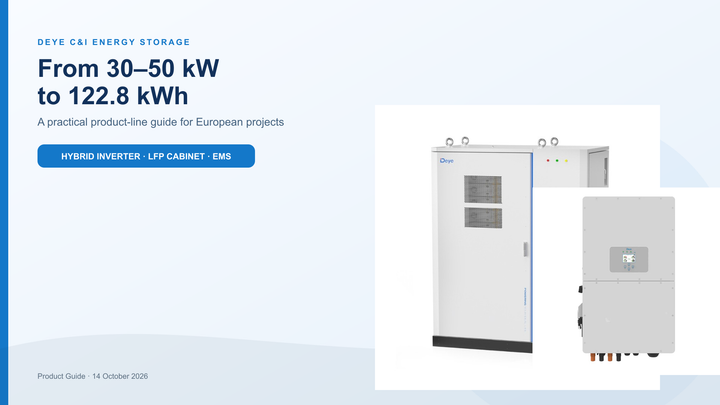
The product line in one view
| Product | Role | Key verified specification | Best fit |
|---|---|---|---|
| GE-F120-2H2 | Integrated outdoor C&I storage cabinet | 122.8 kWh LFP, 50 kW nominal output/UPS power, 500–700 V, IP55 | Shops, hotels, farms, warehouses and light industry wanting one coordinated cabinet |
| GE-F120-3H2 / 4H2 | Lower-power cabinet variants | 122.8 kWh with 40 kW or 30 kW nominal output, depending on model | Longer-duration backup or lower-power peak-shaving sites |
| BOS-G | Modular indoor high-voltage battery system | 5.12 kWh modules; 15.36–61.44 kWh nominal; 13.82–55.29 kWh usable; CAN 2.0 / RS485; IP20 | Technical rooms and staged expansion |
| SUN-30K-SG01HP3-EU-BM3 | Three-phase HV hybrid inverter | 30 kW, three MPPTs, two battery inputs, 160–800 V | Medium commercial loads and 30 kW-class backup |
| SUN-50K-SG01HP3-EU-BM4 | Three-phase HV hybrid inverter | 50 kW, four MPPTs, two battery inputs, 160–800 V | Larger loads, more PV orientations and stronger peak shaving |
1. GE-F120: an integrated cabinet for faster project delivery
The GE-F120 platform combines the energy storage hardware and project controls inside one floor-mounted enclosure. The European GE-F120-2H2 is configured with 122.8 kWh of LFP storage and 50 kW of nominal output/UPS power. Deye lists a 500–700 V battery operating range, IP55 enclosure protection, a maximum round-trip efficiency of 89%, approximate dimensions of 1,780 × 1,056 × 2,235 mm and an approximate weight of 2,090 kg.
Those figures explain the product’s real position in the market. It is a permanent site asset, not a large residential battery. Delivery access, lifting, foundation design, clearances, fire strategy and cable routing have to be planned before the purchase order.
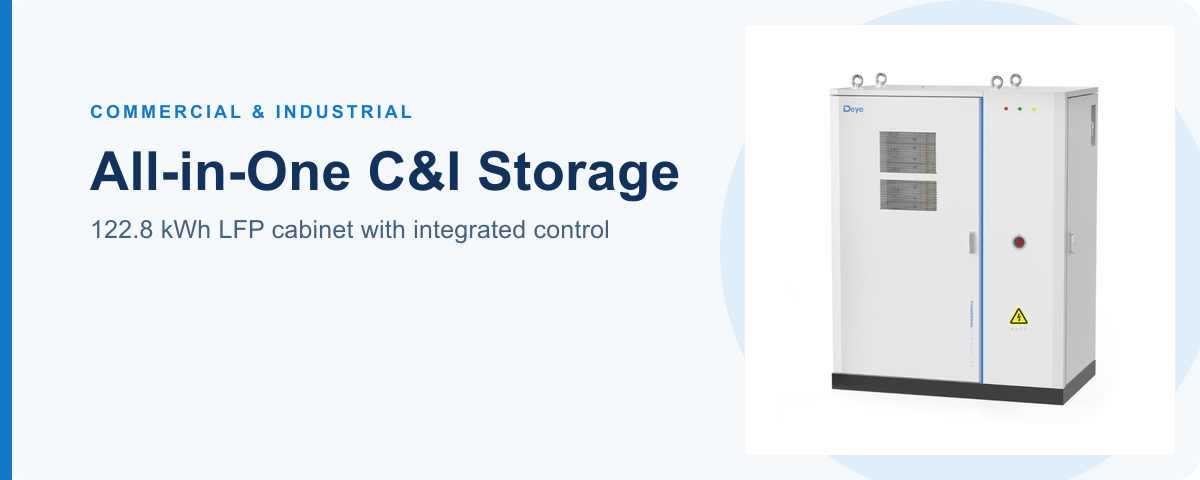
The cabinet integrates local energy management, battery management and power conversion functions. Deye documentation also describes smoke, temperature and combustible-gas monitoring, an exhaust system, aerosol fire suppression, black-start support and off-grid operation. These are valuable functions, but they do not replace the project-specific fire assessment, grid-code review or local authority requirements.
Where the GE-F120 makes commercial sense
- A hotel or retail building that needs to keep reception, lighting, IT, refrigeration and security online during an outage.
- A farm or food-processing site that wants to absorb daytime PV and reduce evening grid purchases.
- A warehouse or workshop with a predictable peak that can be shaved without interrupting production.
- A commercial EV-charging site that needs to reduce short-duration grid peaks.
- A small microgrid where black start and off-grid operation are part of the approved design.
Where it may be the wrong choice
- A site with no measured interval-load data and no defined savings case.
- A building that cannot accommodate the cabinet’s weight, footprint or ventilation requirements.
- A project needing only a few kilowatt-hours of backup.
- A site where the local grid operator has not approved the intended export, zero-export or backup arrangement.
2. BOS-G: modular high-voltage storage for staged expansion
BOS-G uses 5.12 kWh LFP modules in series. Deye lists configurations from three to twelve modules, producing 15.36–61.44 kWh of nominal capacity and 13.82–55.29 kWh of usable energy. The system uses CAN 2.0 and RS485 communication and has an IP20 enclosure rating.
This makes BOS-G attractive when the battery must be installed in a controlled technical room and when the buyer wants to start with a smaller energy block. It also means the project team must treat the rack, high-voltage control equipment, inverter compatibility, temperature conditions and protection devices as one engineered system. The integrated cabinet is usually stronger when installation speed, outdoor packaging and a larger single energy block matter more.
3. Choosing between the 30 kW and 50 kW hybrid inverters
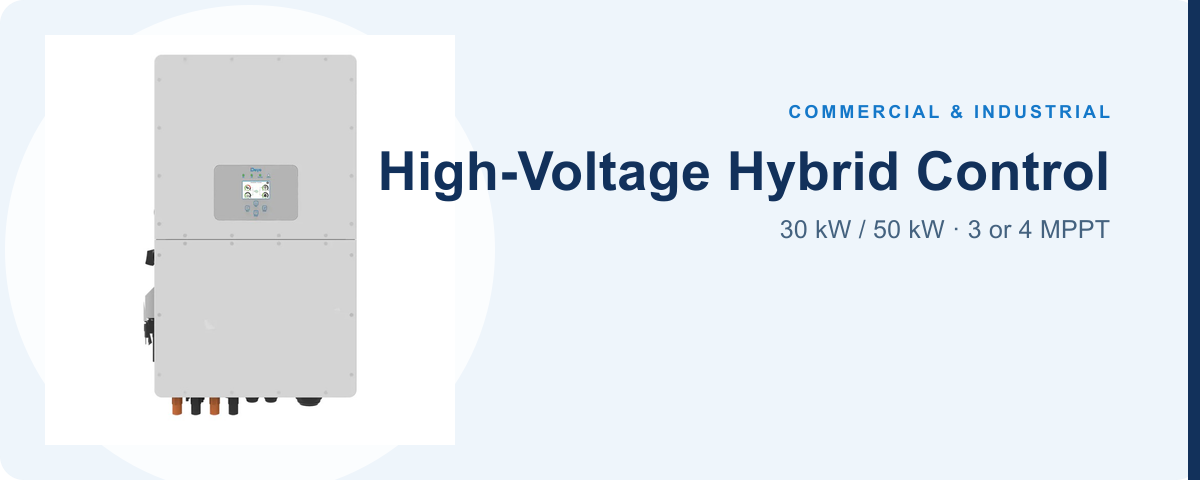
Both units are three-phase high-voltage hybrid inverters with a 160–800 V battery range, two battery inputs and BMS-adaptive lithium-ion charging. Both are rated IP65 and support RS485, RS232 and CAN communication. The main distinction is not simply 20 kW of extra nameplate power.
| Decision point | 30 kW model | 50 kW model |
|---|---|---|
| Rated AC input/output power | 30 kW | 50 kW |
| MPPT count | 3 | 4 |
| Maximum PV input power | 48 kW | 80 kW |
| Maximum PV access power | 60 kW | 100 kW |
| Typical reason to choose | Lower site demand, smaller backup board or longer battery duration | Higher simultaneous load, more PV, more roof orientations or stronger peak shaving |
| Current Solligent listed price* | €3,300 | €4,200 |
*Prices observed on Solligent on 14 October 2026. VAT treatment, delivery, commissioning and project accessories must be confirmed in a current quotation.
If a 122.8 kWh cabinet is discharged at 50 kW, the theoretical nameplate duration is approximately 2.46 hours before system losses, reserve state of charge, temperature effects and operational limits. At 30 kW, the same nameplate energy corresponds to approximately 4.09 hours. This simple ratio is useful for early screening, but it is not a final autonomy calculation.
4. Recommended configuration logic
Good: 30 kW power with modular BOS-G storage
Use for a technical-room installation, a medium commercial load and a project that may expand later. This can be attractive for shops, small offices, telecom sites and workshops where the first priority is controlled backup and PV self-consumption rather than maximum discharge power.
Better: 30–40 kW integrated GE-F120 platform
Use when the buyer wants a larger energy reserve with moderate output power. The energy-to-power ratio is suitable for longer backup duration or slower peak shaving, provided the actual load profile supports the design.
Best for higher-load sites: GE-F120-2H2 at 50 kW
Use when the site has enough critical or controllable load to use 50 kW and when faster charging/discharging materially improves the business case. Typical candidates include hotels, supermarkets, light industrial sites, larger farms and commercial charging locations. “Best” does not mean largest. It means the configuration that produces the best verified combination of savings, resilience and acceptable project risk.
5. What the system can do—and what still requires engineering
Peak shaving and demand management
The battery can discharge during the site’s highest demand periods, but the financial value depends on the local tariff and how the demand charge is calculated. Fifteen-minute interval data is the minimum sensible starting point; one full year is better for seasonal sites.
PV self-consumption
The system can store surplus daytime PV for evening use. The most valuable projects normally have both surplus generation and a predictable later load. Oversizing the battery without enough recurring surplus produces poor utilisation.
Backup power
“Backup” must be defined as a separate load schedule. Motors, pumps, refrigeration compressors and EV chargers can have high starting currents or variable demand. The project should distinguish essential loads, deferrable loads and loads that must be disconnected during islanded operation.
Energy arbitrage
Charging at a low tariff and discharging at a high tariff can add value, but the spread must cover conversion losses, cycling cost and any restrictions imposed by the electricity contract or grid operator.
6. Buying checklist
- Twelve months of electricity bills and interval-load data.
- Critical-load list, starting currents and required backup duration.
- Existing and planned PV string design, including voltage, current and roof orientation.
- Grid connection, export limit, zero-export requirement and applicable national grid code.
- Exact battery-to-inverter compatibility, BMS protocol and approved firmware combination.
- Required energy reserve, depth of discharge and operating state-of-charge window.
- Cabinet foundation, lifting route, service clearances, drainage and cable entry.
- Fire detection, suppression, ventilation and emergency response requirements.
- Ambient temperature, altitude, humidity and any derating conditions.
- Metering, CT orientation, generator integration and EMS control logic.
- Commissioning responsibility, remote monitoring ownership and service escalation route.
- Warranty term for the exact installation country and operating profile.
The BMS and firmware check is especially important when combining a Deye inverter with a third-party battery. A compatibility list alone is not a substitute for confirming the cable pinout, protocol, approved firmware and commissioning procedure for the exact equipment revision.
7. European procurement through Solligent
As of 14 October 2026, Solligent’s “In Stock Only” pages displayed the GE-F120-2H2 cabinet and the 30 kW and 50 kW high-voltage hybrid inverters. The cabinet was listed at €30,000, the 30 kW inverter at €3,300 and the 50 kW inverter at €4,200.
Stock is time-sensitive. A project quotation should confirm VAT treatment, delivery location, freight, unloading, accessories, meters, CTs, communication hardware, warranty territory and commissioning scope. BOS-G rack configurations should be quoted as a complete compatible set rather than as isolated battery modules.
Who should buy it
- EPCs and installers with measured commercial load data.
- Hotels, farms, warehouses, workshops, retail sites and light industrial users seeking both savings and resilience.
- Buyers who can provide a site single-line diagram and accept professional commissioning.
- Distributors serving repeatable 30–50 kW commercial projects.
Who should not buy it yet
- Buyers selecting equipment only from nominal kWh or the lowest online price.
- Sites without a defined critical-load board or verified grid-connection plan.
- Projects without lifting, foundation, fire and ventilation provisions.
- Installations relying on an unconfirmed third-party battery communication protocol.
Request a project quotation
Solligent can support European procurement for the Deye GE-F120-2H2 cabinet and the 30 kW / 50 kW high-voltage hybrid inverter platform. Send the site country, grid type, twelve months of load data, PV size, critical-load schedule, target backup duration and delivery postcode for a configuration review and current quotation.
Official references
- Deye GE-F120-2H2 / 3H2 / 4H2 product page
- Deye BOS-G product page
- Deye SUN-(29.9–50)K-SG01HP3-EU-BM4 datasheet
- Solligent Deye battery collection
- Solligent hybrid inverter collection
Specification note: Product specifications, compatibility, certificates, warranty coverage, prices and inventory can change. Confirm the exact model revision and project country before purchase.